The concept of a “universal power” in the Law of Attraction (LoA) often raises questions about its relationship to traditional religious beliefs, particularly the idea of God. This universal power is described in various ways by different people, and while some view it as synonymous with God, others see it as a distinct force or principle. Here, we explore the nature of this universal power in the LoA and how it relates to the concept of God.
Understanding the Universal Power in LoA
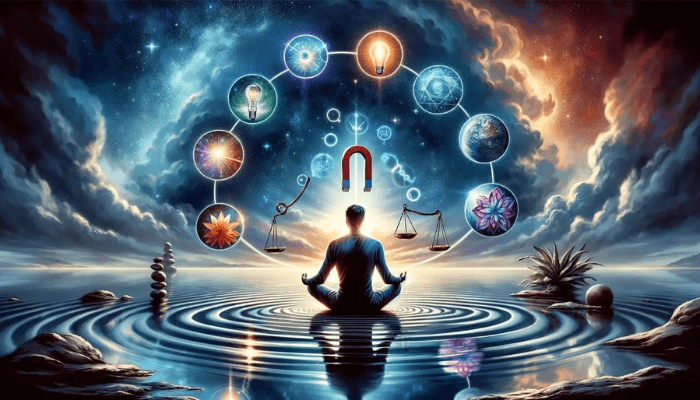
The Law of Attraction posits that a universal power or energy responds to our thoughts and feelings, attracting corresponding experiences into our lives. This power is often described in metaphysical and spiritual terms, emphasizing the connection between individual consciousness and the broader universe.
Key Characteristics of the Universal Power in LoA:
- Omnipresence: The universal power is seen as present everywhere, influencing all aspects of life.
- Interconnectedness: It connects all living beings and is the source of all energy and matter in the universe.
- Responsive Nature: This power responds to the vibrations of our thoughts and emotions, manifesting similar energies in our physical reality.
- Impersonal Force: Unlike a personal deity, the universal power in LoA is often viewed as an impersonal force that operates according to universal laws.
The Universal Power and God: Similarities and Differences
While the universal power in the LoA shares similarities with the concept of God in many religious traditions, there are key distinctions to consider.
Similarities:
- Creation and Influence: Both the universal power and God are viewed as fundamental forces that create and influence the universe.
- Interconnectedness: Both concepts emphasize the interconnectedness of all things, suggesting that every part of the universe is linked.
- Omnipresence: Both are considered omnipresent, existing everywhere and in everything.
Differences:
- Personal vs. Impersonal: God in many religious traditions is often seen as a personal deity with whom individuals can have a relationship. The universal power in the LoA is typically described as an impersonal force that operates through universal laws without personal attributes.
- Agency and Intent: In many religions, God is seen as having agency, will, and intent, guiding the universe and human destiny. The universal power in the LoA is more of a neutral force that does not act with intention but rather responds to the energy and vibrations sent out by individuals.
- Religious Context: God is central to religious worship and practices, whereas the universal power in the LoA is part of a broader spiritual or metaphysical worldview that may or may not involve traditional religious practices.
Integrating the Concepts
For many, the universal power in the LoA and God are not mutually exclusive and can be integrated into a cohesive belief system.
God as the Universal Power: Some people interpret the universal power as another aspect or manifestation of God. They see the principles of the LoA as ways in which God’s influence is experienced in the world.
Spiritual Principles: Others view the universal power as a set of spiritual principles established by a higher intelligence (God), through which the universe operates. In this view, the LoA is one of the many ways that divine order and harmony are maintained.
Interfaith Perspectives: Many find that the universal power concept aligns well with various spiritual and religious traditions, allowing for an inclusive and broad understanding of divine influence. For instance, concepts similar to the LoA can be found in Buddhism, Hinduism, and New Thought Christianity.
Conclusion
The universal power in the Law of Attraction can be understood in various ways, and its relationship to the concept of God depends largely on individual belief systems. While some see it as synonymous with God, others view it as a distinct, impersonal force that operates through universal laws. The LoA’s emphasis on positive thinking, visualization, and belief in the interconnectedness of all things resonates with many religious and spiritual teachings, allowing for a diverse and inclusive interpretation. Whether viewed as God, a divine principle, or an impersonal universal force, the idea underscores the profound influence of our thoughts and emotions on our experiences and the world around us.